Agentic CRM and CPQ

A CRM that drafts the proposal, not just the reminder to send one.

SimpleGrowth runs pipeline for services teams: companies, contacts, deals, activities, and the quote that comes out the other end. The difference is what happens between those records. Agents read the deal, the meeting transcript, and the source material you uploaded, then draft the next email, the statement of work, and the proposal with the reasoning attached so a human can check the work before it goes out.

Run it as your CRM of record, or run it alongside Microsoft Dynamics 365, Salesforce, and HubSpot. Read-only connection verification for all three ships today, and production two-way sync is in development.

Free tier is one seat, free for 60 days, no card, and extendable on request. Paid tiers start at $99 per month flat for up to five seats.

Watch it work

A short walkthrough of the parts that are hard to explain in text: the dashboard, a live deal, the drafted proposal, and the weekly leadership meeting.

Read the transcript instead

[00:02] Simple Growth is a CRM and quoting tool for teams whose real problem is not storing contacts. It is the work that piles up around them. Notes that never turn into a follow-up, proposals that take three days to write, and a Monday meeting that runs on whatever somebody remembered.

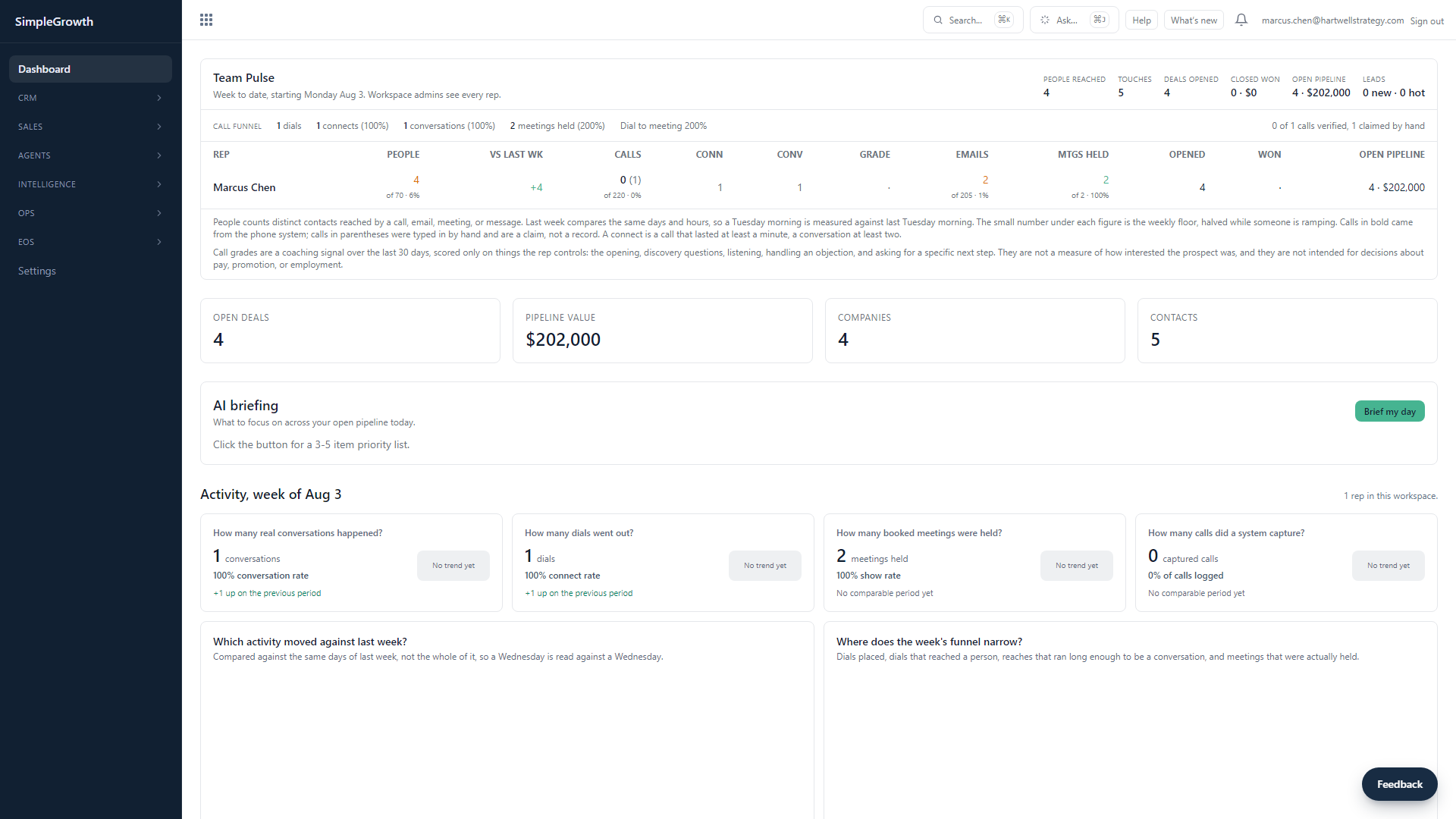
[00:19] Sign in and the first screen is what moved since yesterday. Pipeline by stage, the deals that went quiet, and the activity your team actually logged, captured from Microsoft 365 rather than typed in twice. Nobody has to remember to update the CRM for the CRM to be current, which is the difference between a system of record and a chore.

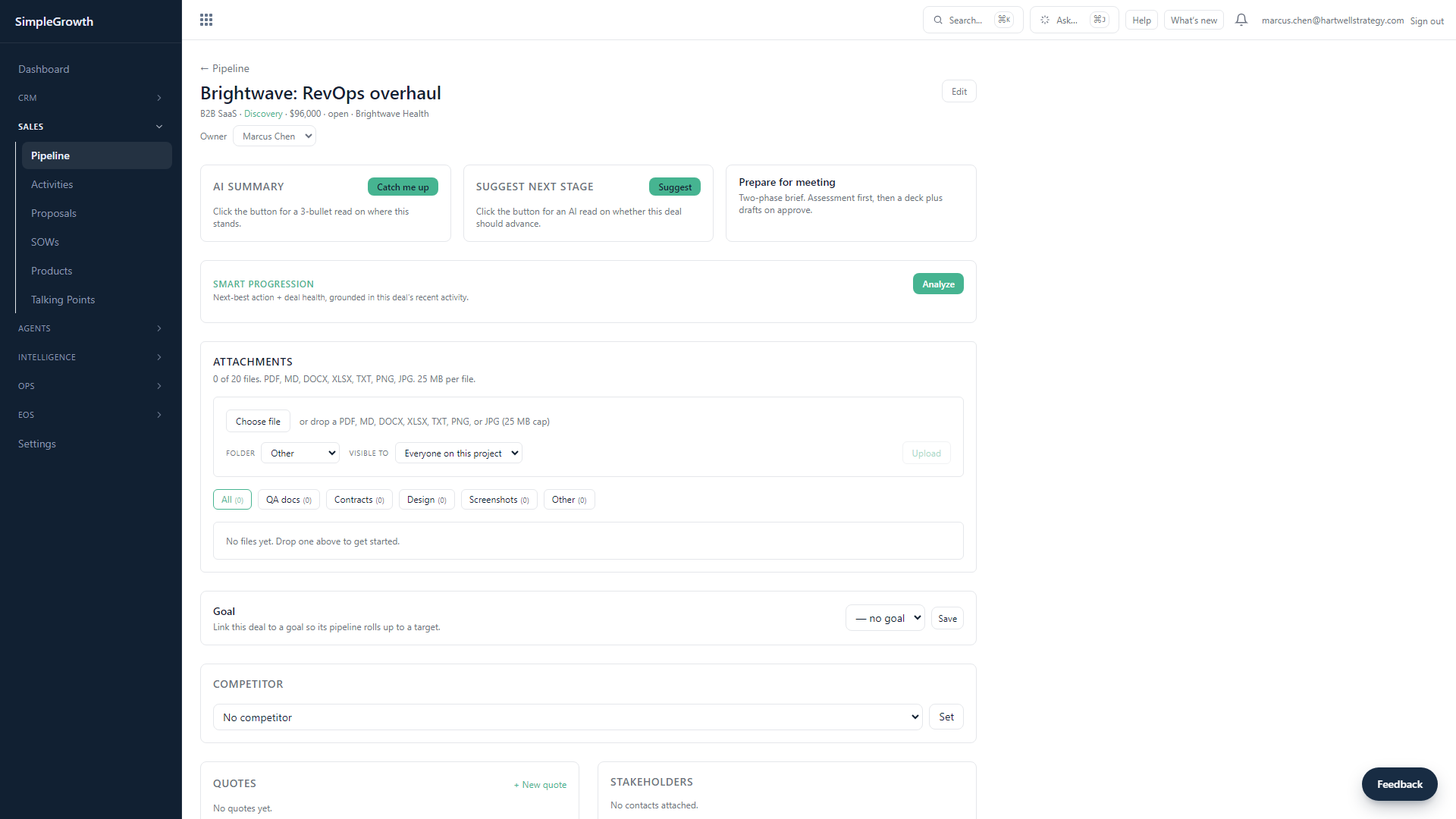
[00:41] Open a deal and you get the usual: value, stage, the people involved, every email and call attached. Underneath that is the part that is new. The agent reads the deal and proposes the next step, and it shows the reasoning that produced it. You can disagree with it, because you can see what it looked at. Every record the agent touches is stamped with that reasoning and kept, so a suggestion is auditable months later.

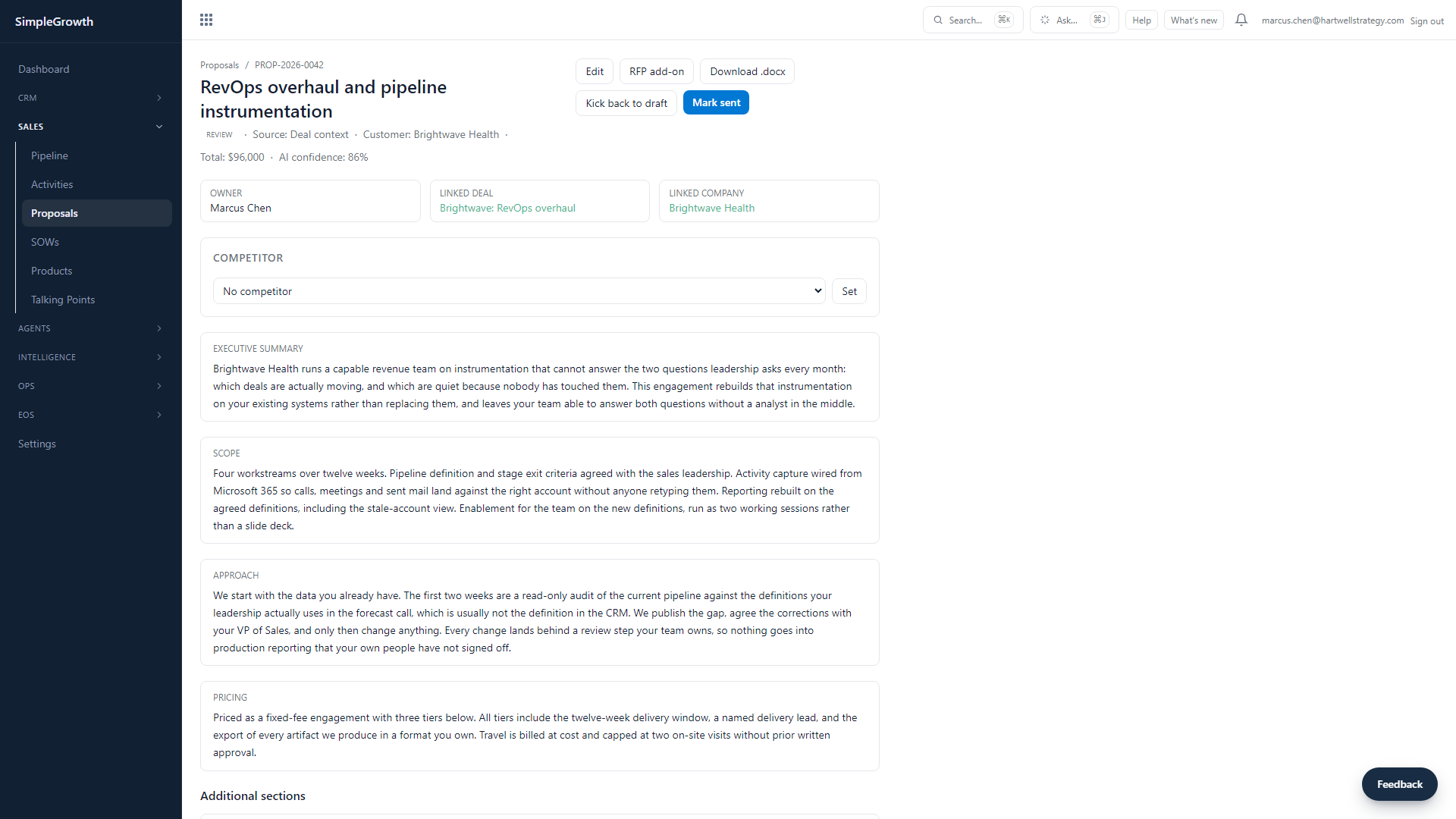
[01:07] This is the part that changes the week. Take that same deal and ask for a proposal. The drafter reads the deal context, the notes, the earlier proposals you have already won, and the requirements document if the buyer sent one, then produces a real draft with scope, approach and priced tiers. If it came from a request for proposal, you get a compliance matrix mapping each requirement to where you answered it. It renders to Word, so your team edits it the way they already edit everything else.

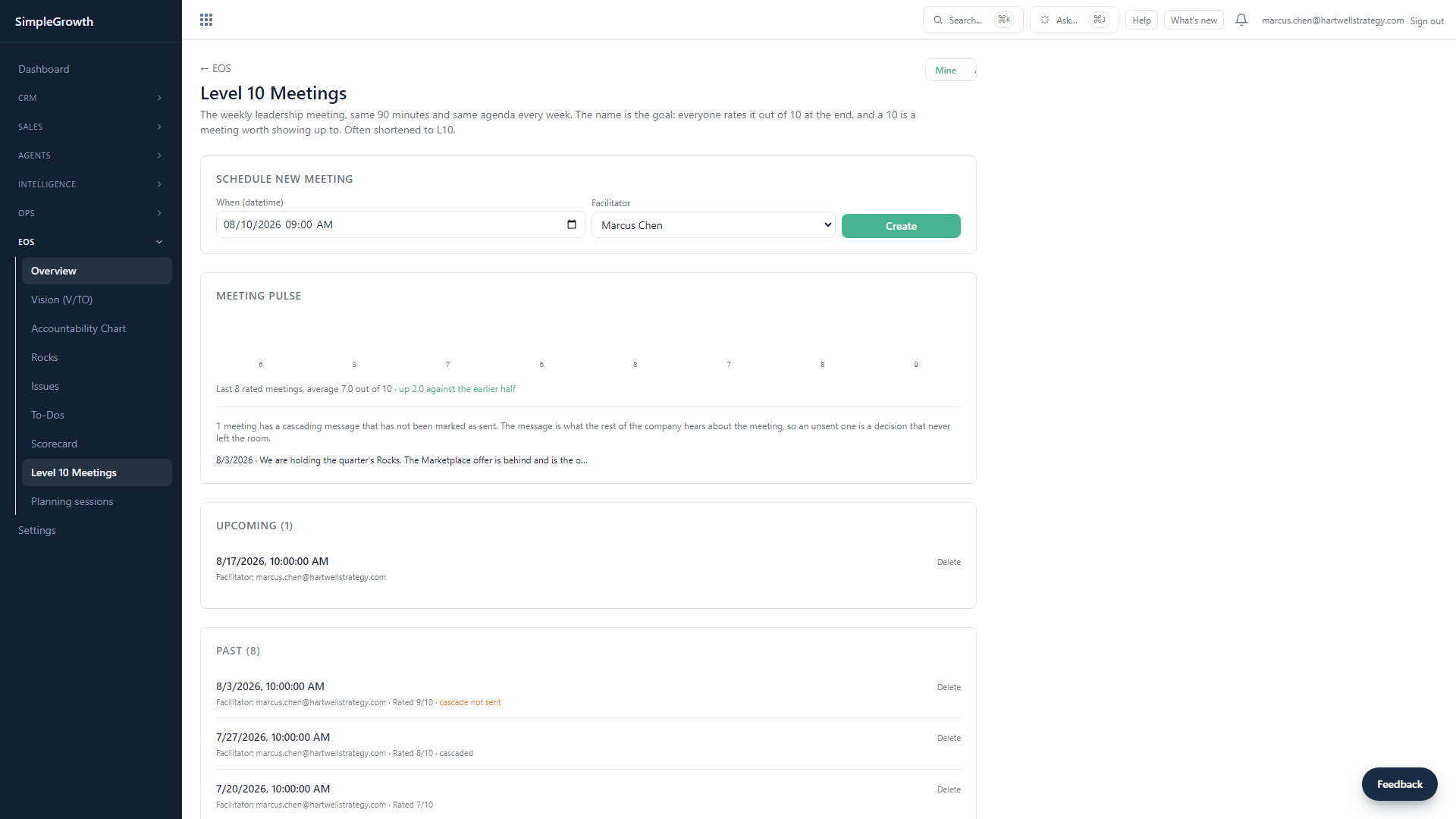
[01:37] Simple Growth also runs the meeting. The Entrepreneurial Operating System, from Gino Wickman's book Traction, gives a leadership team a weekly agenda, a scorecard of numbers, quarterly priorities called Rocks, and a list of issues to work through. The Level 10 Meeting screen holds all of it in one place, and the ten is the score the team gives the meeting when it ends. Simple Intelligence Group is not affiliated with EOS Worldwide, and this is our reading of a published method.

[02:07] Start free for one user at growth dot simple intelligence group dot com, or buy through the Microsoft commercial marketplace and put it on an agreement you already have. Connect Salesforce, HubSpot or Dynamics 365 and Simple Growth verifies the connection today, with two-way sync in development. The Enterprise agreement carries a portability clause with zero exit fees. The export tooling behind it is still on the roadmap, and we would rather tell you that now than at renewal.
What you get

Everything below is in the product today. Nothing here is a roadmap item.

Pipeline

Deals that tell you what to do next

Companies, contacts, deals, and activities with the usual pipeline views, plus a suggested next step on every open deal. Each suggestion stores the confidence and the reasoning that produced it, so a rep can disagree with the agent and see exactly what it was reading when it was wrong.

CPQ

Proposals and statements of work, drafted

Point the drafter at a deal, an uploaded RFP, notes from a planning session, or a blank prompt. It retrieves your own past work through vector search, scaffolds against the template for that industry, and renders to .docx. RFP responses add a compliance matrix, a clause grid, pricing tiers, and bid scoring.

Prospecting

Lists, enrichment, and a sales development agent

Build a cohort from an ideal-customer filter, enrich it, and gate it on quality before anything reaches a rep. Engagement events from email, forms, proposals, and bookings score each lead and age it back down when the interest goes quiet, so the call list is ordered by who is actually warm.

Meetings

Prepared before, captured after

Every upcoming meeting gets a brief built from the record graph and recent activity. Afterwards the transcript comes back as a recap with the commitments pulled out. Calendar and Teams Phone call records sync read-only from Microsoft 365, metadata only, never message bodies.

Operating cadence

The weekly leadership meeting, run properly

A scorecard, quarterly rocks, an accountability chart, a long-term vision document, and a same-day issues list, in the format the Entrepreneurial Operating System describes. The meeting screen keeps the agenda on the clock and turns unresolved items into tracked issues instead of forgotten ones.

Search

One box across everything

Semantic search over the whole workspace, with a plain substring fallback when the phrasing is exact. Records stay scoped to your workspace and to what your role is allowed to see, because visibility is enforced in the query, not hidden in the interface.

The Entrepreneurial Operating System and EOS are described in Traction by Gino Wickman. Simple Intelligence Group is not affiliated with, endorsed by, or certified by EOS Worldwide. SimpleGrowth implements the meeting and planning structures the book describes; it is not an official EOS product.

The actual product

SimpleGrowth dashboard showing pipeline by stage, this week's activity, and open deals.
The dashboard opens on what changed since yesterday, not on an empty search box.
A SimpleGrowth deal record with stage, value, contacts, and the agent-suggested next step.
Every deal carries the agent's suggested next step alongside the reasoning that produced it.
A SimpleGrowth proposal drafted from deal context, with pricing tiers and a compliance matrix.
Proposals draft from deal context and stored source material, then render to .docx.
The SimpleGrowth Level 10 meeting screen with segue, scorecard, rocks, and the issues list.
The leadership meeting runs on a fixed agenda with a scorecard and an issues list attached.

Better Together with Dynamics 365

We are not asking you to rip out your CRM.

Most agentic sales tools open with a migration. SimpleGrowth does not. The Growth tier is priced at $89 per seat, under the $105 Microsoft charges for Dynamics 365 Sales Enterprise, because the intended purchase is an addition to your Microsoft investment rather than a replacement for it. You keep Dynamics as the system of record and get cross-CRM agents, agentic CPQ, and Microsoft Graph depth that Sales Copilot does not ship today.

What that means concretely right now: SimpleGrowth verifies a read-only connection to Dynamics 365, Salesforce, and HubSpot, imports the record graph, and applies a fill-blanks merge that can populate an empty field but can never overwrite a value one of your reps typed. Genuine disagreements go to a review queue instead of being resolved silently. Production two-way sync is in development and is not something you are buying today.

Lifeboat clause, Enterprise tier

Your data stays yours, in writing.

The Enterprise agreement carries a portability clause: zero exit fees, regardless of jurisdiction, aligned with the EU Data Act (Regulation 2023/2854). The contractual right applies today. The on-demand export tooling and machine-readable schema documentation that operationalize it are on the roadmap, and we would rather say so here than have you find out at renewal. The reason the clause exists is simple: a vendor who is confident about retention does not need switching costs to hold onto customers.

Two ways to pay for it

Same product either way. The difference is whose invoice it lands on.

Sign up directly

Card or invoice, no procurement cycle. Start on the free tier with one seat for 60 days, ask for an extension from inside the app if you need longer, and move up when a second person needs an account. The $99 per month flat Starter Pack covers up to five seats and only exists on this path.

Start free

Microsoft Azure Marketplace

Bought on your Microsoft Customer Agreement and invoiced by Microsoft, which means it can draw down a Microsoft commitment and skips a separate vendor onboarding. Per-seat from $17, with a one-month free trial on the Starter plan.

Compare both paths

How it is built

Isolated per workspace

Every record carries a workspace id and every query filters on it server-side. There is no global fallback that could return another customer's rows.

Microsoft Entra ID sign-in

Sign in with your work account across organizations, with Google and email-based sign-in available. Roles are administrator, member, and viewer, and members see only what they are assigned to.

Runs on Azure

Hosted on Azure Container Apps in East US 2 behind Azure Front Door, on managed Postgres. Secrets resolve from Azure Key Vault at runtime rather than living in the application.

AI work is attributable

Anything an agent wrote is stored with a flag, a confidence value, and the reasoning behind it. You can always tell which fields a person filled in and which ones a model did.

Compliance evidence is available under NDA. Ask us at sales@simpleintelligencegroup.com.

Start with one seat and a real deal.

The free tier runs 60 days on one seat and needs no card. Put one live opportunity in, let the drafter write the proposal, and decide from there. If 60 days is not enough, ask for an extension from inside the app.